


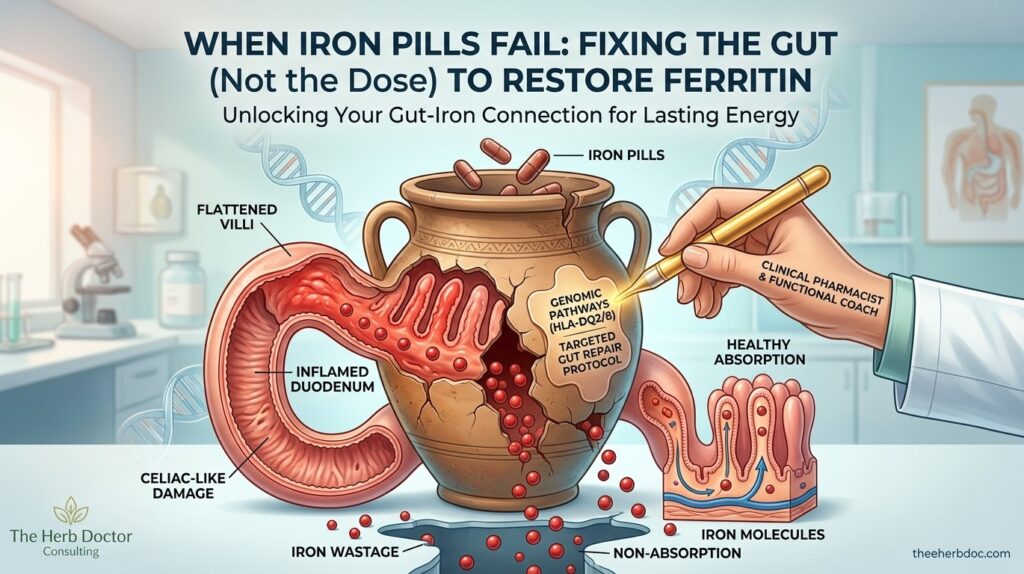
If you have spent months or years taking prescription iron supplements only to watch your ferritin levels hover in the single digits or low teens, you know how frustrating—and exhausting—it can be.
Brain fog, heavy limbs, afternoon crashes, and cold hands are often brushed off as “normal stress.” But when iron pills fail to resolve the issue, the problem is rarely that you aren’t taking enough iron.
The problem is usually that your gut cannot absorb it.
Pat’s Story: The “Picky Eater” Myth

When Pat was a child growing up in an Italian household, traditional wheat-based bread made her feel sick to her stomach. Whenever she pushed her plate away, her family gave her the same gentle lecture: “She’s so picky. Just eat.”
Wanting to be a good daughter, she forced herself to eat. She remained the smallest child in her classroom, experienced frequent nausea after dinner, and gradually learned to ignore her body’s internal distress signals.
Fast forward to age 47. Pat sought clinical guidance because she was completely drained of energy. Her ferritin (the storage form of iron) was sitting at 11 ng/mL—despite having just finished her third consecutive round of oral iron therapy.
When we ordered a comprehensive genomic panel, we found a critical piece of her health puzzle: she carried HLA-DQ2, one of the primary gene variants associated with celiac disease and significant gluten reactivity.
The Anatomy of Iron Absorption: Why the Duodenum Matters
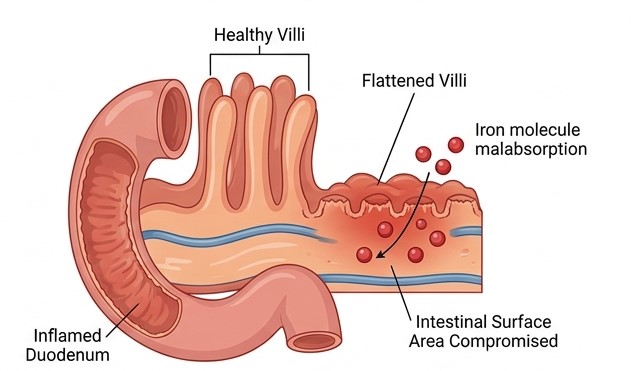
To understand why Pat’s iron levels wouldn’t rise, we have to look at the micro-anatomy of the human digestive tract.
Unlike many other nutrients that can be absorbed across various segments of the intestine, dietary and supplemental iron is almost exclusively absorbed in the duodenum—the short, C-shaped first section of the small intestine directly connected to the stomach.
When a person with genetic gluten sensitivity consumes gluten:
-
An autoimmune reaction triggers inflammation along the mucosal lining of the duodenum.
-
The microscopic, finger-like projections responsible for nutrient uptake (intestinal villi) become flattened or damaged.
-
Because the iron-absorbing surface area is compromised, iron molecules pass right through the digestive tract without entering the bloodstream.
Pat was swallowing iron every morning, but her inflamed gut was physically incapable of absorbing it.
The Hidden Gluten Trap: Beyond Bread and Pasta to Low Iron
When Pat learned about her HLA-DQ2 gene, she was surprised. She had already cut back on traditional breads and pastas months earlier. Why was her gut still under attack?
Gluten cross-contamination is a silent disruptor. For individuals with genetic susceptibility, even micro-gram exposures can sustain low-grade intestinal inflammation. Gluten was quietly sneaking into her diet through:
-
Pre-ground spices and store-bought masalas (frequently processed on shared equipment or using wheat starch anti-caking agents).
-
Restaurant sauces and gravies (thickened with wheat flour).
-
Cross-contaminated cookware and shared kitchen surfaces.
When she finally understood her report, tears came to her eyes. “So I wasn’t being picky,” she said. “My body was trying to protect me all along.”
A Pharmacist’s Reflection: From Pill-Dispensing to Root-Cause Healing of Low Iron

For over twenty years behind the traditional retail pharmacy counter, I filled thousands of iron prescriptions. I carefully counseled patients to take their iron with Vitamin C and avoid dairy or coffee within two hours of their dose.
However, I rarely asked the most important question: Why is this patient’s iron low in the first place?
If a leaking bucket isn’t holding water, adding more water isn’t the solution—you have to patch the hole. In clinical practice today, my guiding principle for metabolic and nutrient health is clear:
You cannot out-supplement a gut that is under constant attack.
Are You Suffering From Refractory Low Iron?
If you are struggling with low iron that resists treatment, review this checklist to see if your symptoms match an underlying gut or genetic issue:
-
[ ] Low Ferritin That Won’t Budge: Your levels remain low despite months of oral iron supplementation.
-
[ ] History of “Picky” Eating: You were labeled a fussy eater or experienced frequent stomach discomfort as a child.
-
[ ] Post-Prandial Distress: You experience bloating, gas, or brain fog after dining out or eating complex meals.
-
[ ] Persistent Fatigue: You experience an unyielding 3 PM energy crash, regardless of how many hours you sleep.
-
[ ] Unexplained Nutrient Deficiencies: You also struggle with low Vitamin D, B12, or Folate levels.
How Genomic Testing Unlocks Your Blueprint
You do not have to guess what is happening inside your body. Modern genomic testing uses a simple saliva sample to evaluate key genetic pathways:
-
HLA-DQ2 & HLA-DQ8 Testing: Identifies your genetic predisposition to celiac disease and severe gluten reactivity.
-
Nutrient Transport Pathways: Evaluates how efficiently your body is genetically wired to absorb and utilize essential micronutrients, including iron, folate ($\text{MTHFR}$ variants), and Vitamin D.
-
Inflammatory & Detox Markers: Map out your body’s natural antioxidant defense system and Phase II detoxification capacity.
Once you know your genetic predispositions, you can stop wasting money on random supplements and begin a targeted gut-healing protocol that restores your digestive membrane, calms systemic inflammation, and allows your body to absorb iron naturally.
Ready to Find the Root Cause of Your Fatigue?
At The Herb Doctor Consulting, we combine clinical pharmacy expertise with functional health coaching and advanced genomic testing to help you uncover why your body is struggling—and build a personalized roadmap to restore your vitality.