


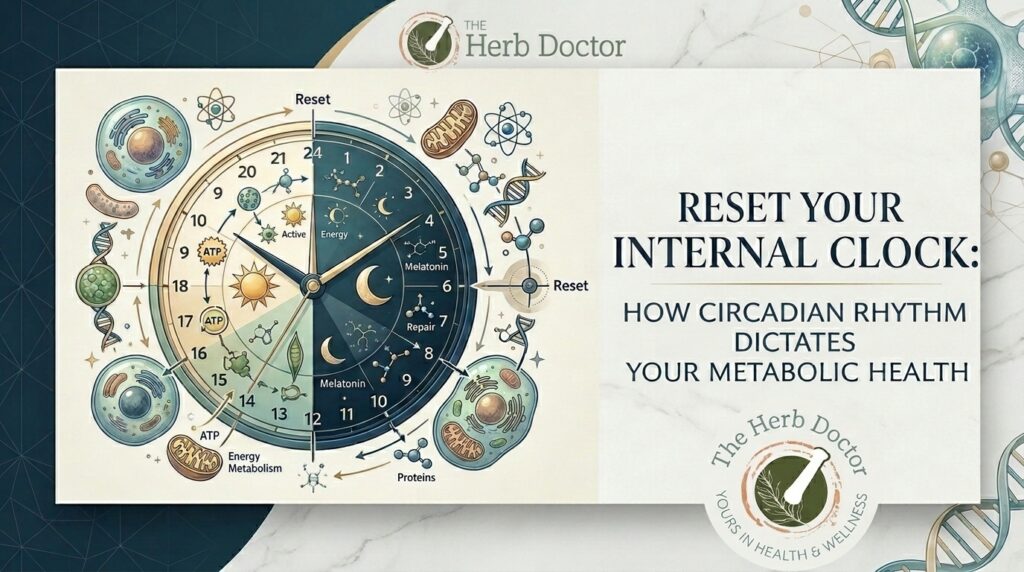
Circadian Rhythm. When midlife women come to my practice struggling with stubborn weight gain, poor sleep, and declining energy, their first instinct is almost always to look at their plates. They meticulously track macros, cut out carbs, or experiment with the latest restrictive dieting trend.
Yet, time and again, these efforts stall out. Why? Because they are treating metabolism as a simple equation of calories in versus calories out, completely ignoring the master conductor of human biology: the circadian rhythm.
Your metabolism is not governed solely by what you eat. It is fundamentally governed by when you eat, when you sleep, and when your cells are exposed to light.
The Master Clock and Peripheral Metabolic Clocks
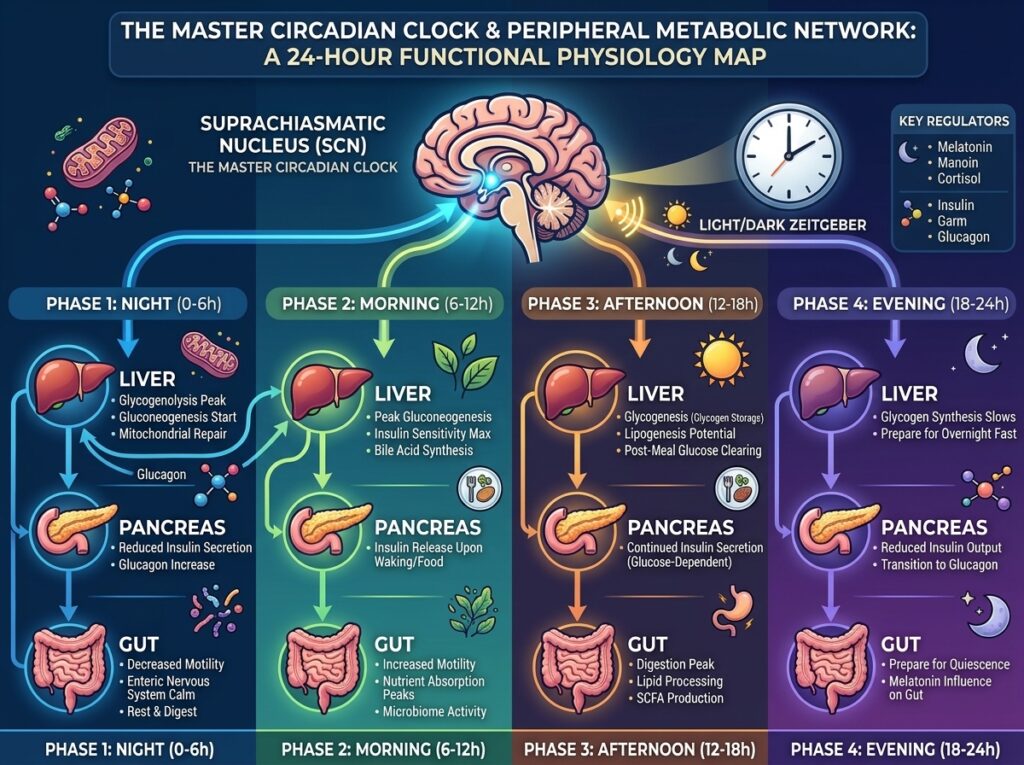
Most people associate the circadian rhythm exclusively with sleep architecture. In reality, modern chronobiology has revealed that nearly every cell in the human body contains its own independent clock genes.
While your brain houses a master clock (the suprachiasmatic nucleus) that responds directly to light and dark, peripheral clocks operate inside your metabolic organs—including your liver, pancreas, skeletal muscle, adipose tissue, and gut microbiome.
When your lifestyle aligns with the natural 24-hour solar cycle, these peripheral clocks harmonize, ensuring that insulin sensitivity, digestive enzyme output, liver detoxification, and mitochondrial energy production peak at the optimal times of day.
When your lifestyle disrupts this cycle, your internal organs become metabolically misaligned.
How Circadian Disruption Sabotages Your Metabolism
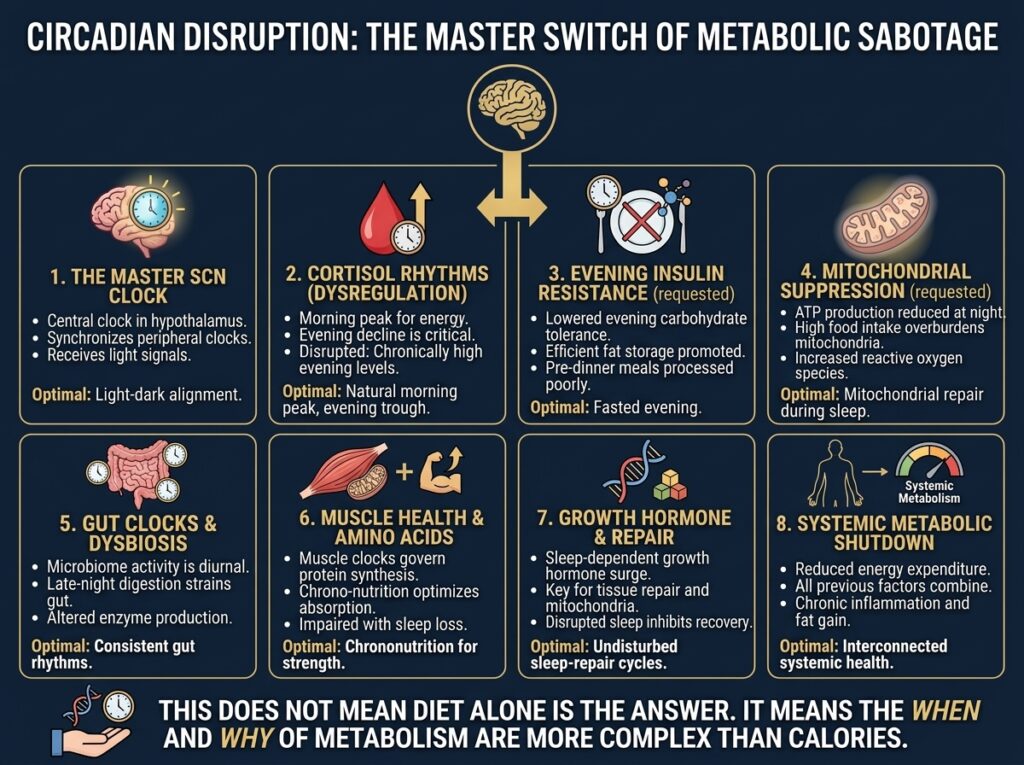
Modern life is a masterclass in circadian disruption: indoor living under artificial fluorescent bulbs, nighttime screen exposure, late-night snacking, and erratic sleep schedules.
When your circadian biology is fractured, the metabolic consequences are profound:
-
Evening Insulin Resistance: Glucose tolerance and insulin sensitivity naturally peak in the morning and decline sharply as evening approaches. Eating heavy, carbohydrate-dense meals late at night forces a sluggish evening pancreas to pump out excess insulin, driving fat storage and morning blood sugar instability.
-
Mitochondrial Suppression: Your cellular powerhouses (mitochondria) follow a diurnal rhythm. Disrupted sleep patterns and constant artificial light exposure impair mitochondrial biogenesis, leading to chronic cellular fatigue and brain fog.
-
Hormonal Dysregulation: Cortisol, melatonin, ghrelin (hunger hormone), and leptin (satiety hormone) operate on delicate circadian feedback loops. When these loops break down, late-night cravings spike, satiety signals disappear, and your stress response remains locked in overdrive.
-
Gut Microbiome Dysbiosis: The trillions of microbes residing in your digestive tract also follow a circadian rhythm. Eating outside your biological window alters microbial diversity, breaking down gut barrier integrity and increasing systemic inflammation.
How to Align Your Circadian Rhythm for Metabolic Healing
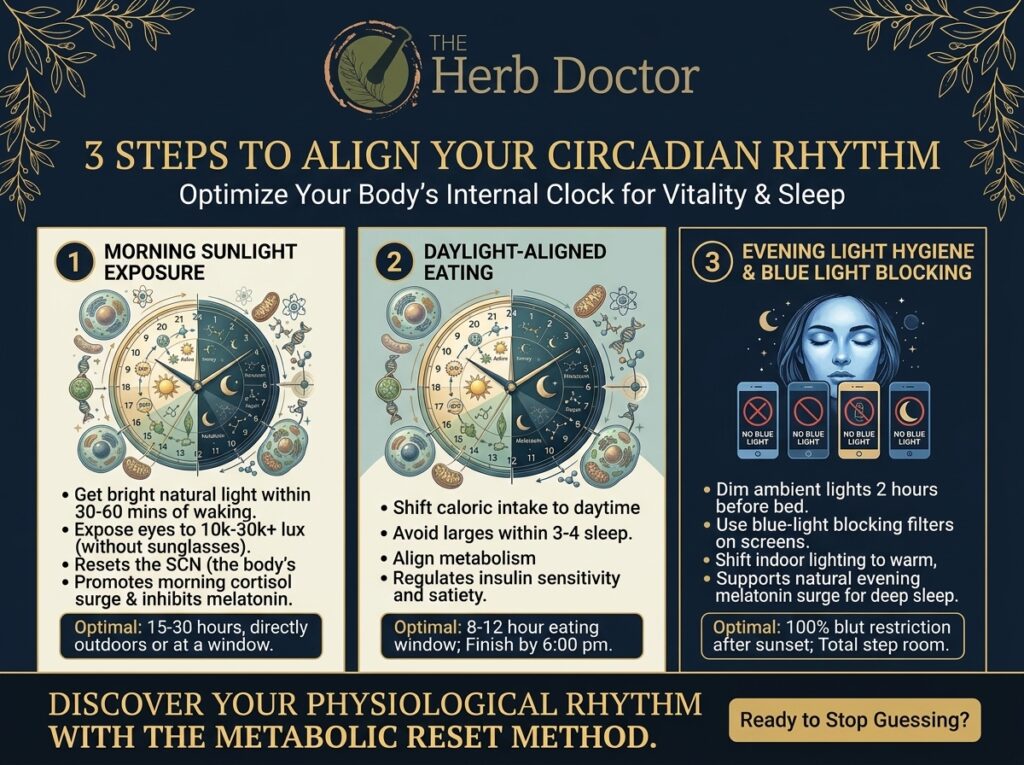
You do not need an extreme lifestyle overhaul to start resetting your internal clock. Small, strategic shifts signal safety and timing to your cellular machinery:
-
Seek Morning Sunlight: Get outside within 60 minutes of waking for 10 to 15 minutes of natural sunlight exposure without sunglasses. This photon input hits your retinal receptors, sets your master clock, optimizes daytime cortisol, and triggers a healthy melatonin countdown for that evening.
-
Practice Daylight-Aligned Eating: Consume your largest, most nutrient-dense meals earlier in the day when your metabolic and insulin sensitivity are at their peak. Give your digestive tract a solid 12-to-14-hour overnight fast to allow cellular autophagy and cleanup processes to occur.
-
Practice Evening Light Hygiene: Dim overhead lights and eliminate blue light exposure (phones, laptops, TVs) at least an hour before bed. This allows natural melatonin production to rise unhindered, preparing your brain and body for deep, restorative sleep.
Reclaim Your Vitality With the Metabolic Reset Method
Circadian biology proves what functional medicine has known all along: your body is an interconnected ecosystem, not a math problem.
If you are tired of chasing quick-fix diets that ignore your actual physiology, it is time for a deeper approach. Through the Metabolic Reset Method, we look past standard “normal” labs to evaluate your metabolic flexibility, hormone rhythms, and cellular health from the ground up.
Three months from now, you can stop fighting your biology and start working with it to get your energy and your edge back.
👉 Ready to stop guessing and build a metabolic strategy tailored to your actual biology?